

Hi there! How can we help you today?
Voices for Health
-
Home
-
Voices for Health

Voices for Health

Start
May 08, 2025
Place
kibaale, uganda
Community Radio for HIV Information, Dialogue and Linkage to Care
Bringing trusted health information closer to rural communities
Voices for Health is a community health communication initiative of Rural Smiles Foundation that uses local radio, interactive public dialogue and community-level follow-up to improve access to accurate HIV information and connect rural communities with appropriate health services.
The initiative was developed in response to concerns raised during consultations with local leaders in Kibaale District about persistent misinformation, stigma and silence surrounding HIV. These barriers can prevent people from asking questions openly, knowing when and where to seek testing, understanding treatment, or supporting family and community members living with HIV. Voices for Health responds by taking reliable health information beyond health facilities and into a platform that people can access within their homes, workplaces and communities.
Why the project matters
Uganda has made substantial progress in its HIV response, but HIV remains an important public health issue. Uganda's Ministry of Health reported that HIV prevalence among adults aged 15 years and above declined from 7.2 percent in 2010 to 5.3 percent in 2023. Gender disparities nevertheless remain: prevalence among women was reported at 6.5 percent compared with 3.3 percent among men. For rural communities, progress in biomedical prevention and treatment must be accompanied by accessible information, reduced stigma, early testing, treatment literacy and trusted pathways to health services.
Kibaale District has a population of 237,649 people, including 124,394 females and 113,255 males, according to Uganda's 2024 National Population and Housing Census. Reaching geographically dispersed communities consistently therefore requires communication approaches that can extend beyond facility-based health education. Uganda's National Community Health Strategy also recognises the importance of increasing demand for and utilisation of community health services, strengthening referral linkages between communities and health facilities, and ensuring culturally acceptable and accessible health services at household level. Voices for Health contributes to this approach by combining mass communication with interaction, community engagement and referral.
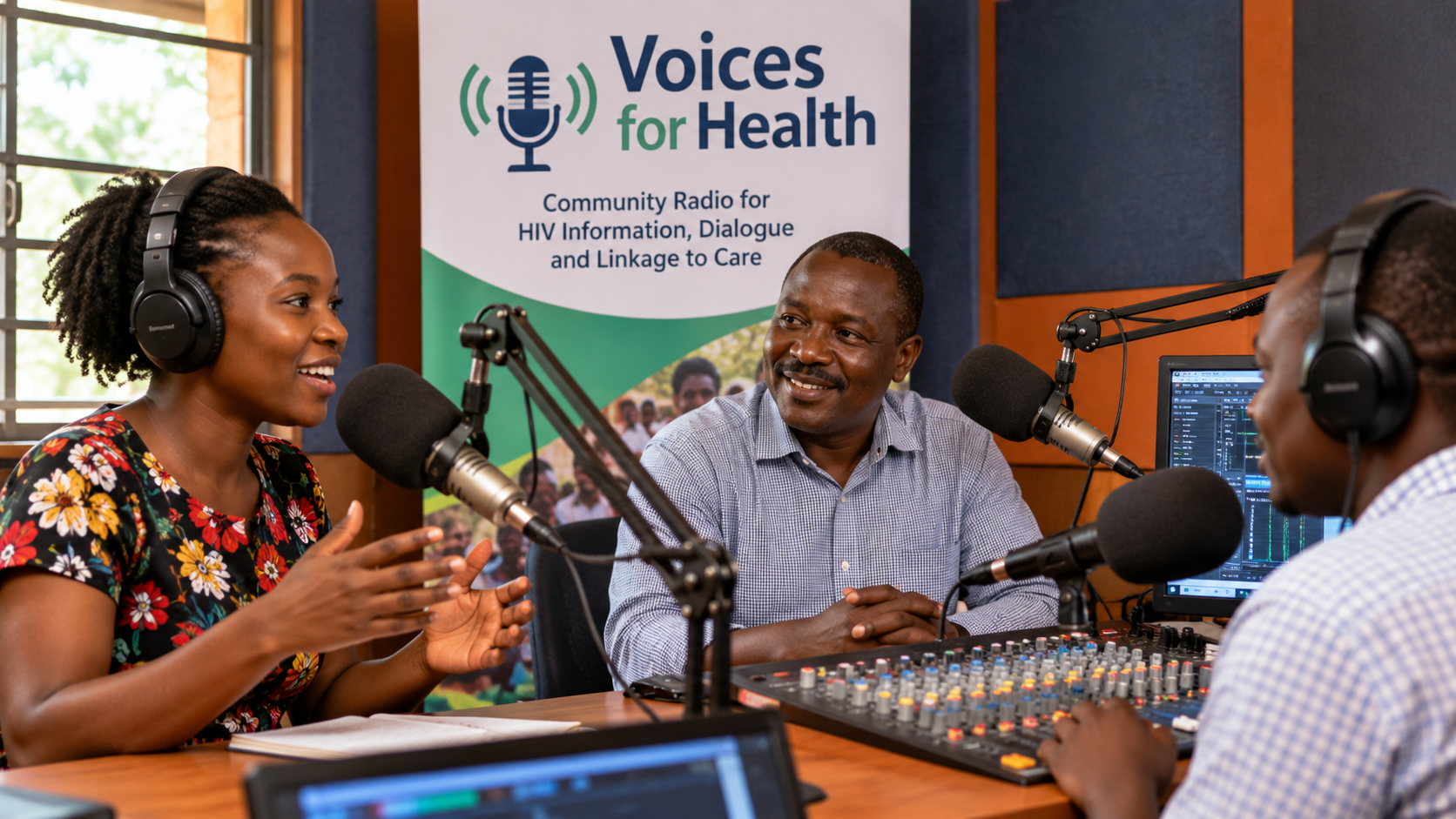
Why community radio?
Radio allows health information to reach people who may not regularly attend organised community meetings, have reliable internet access, use social media, or visit a health facility unless they are already unwell. But Voices for Health is designed to be more than one-way broadcasting. Listeners are able to participate in discussions, ask questions and seek clarification about issues that may be difficult to discuss publicly. This creates an opportunity to address misinformation as it emerges and gives health professionals a platform to explain HIV prevention, testing and treatment in accessible language. The project therefore uses radio as both an information channel and a community dialogue platform.
How Voices for Health works
1. Interactive health radio programmes
Voices for Health was launched through regular broadcasts on KDR FM 100.3 MHz, a local radio station serving communities in and around Kibaale District. The programmes bring health professionals and community audiences together to discuss HIV in a practical, respectful and understandable way. Rather than relying only on prepared health messages, the interactive format enables listeners to ask questions and raise concerns through telephone calls, messages and other available communication channels.
2. Expert-led health information
Health professionals provide medically grounded information during the programmes. Topics include HIV transmission and prevention, testing, treatment, adherence, stigma, relationships, young people's health, living positively with HIV and accessing available health services. This professional participation is important because misinformation about HIV can directly influence individual health decisions. Dr. Richard Lubega has supported the initiative as a medical expert, helping explain health issues and respond to listeners' questions during broadcasts.
3. Addressing misinformation and stigma
Knowledge alone does not determine whether someone seeks HIV testing or treatment. Fear of discrimination, misconceptions about transmission, concerns about confidentiality and negative attitudes toward people living with HIV can also influence behaviour. Voices for Health therefore incorporates stigma reduction throughout the programme rather than treating it as a separate issue. Discussions challenge common myths, promote respectful attitudes toward people living with HIV and reinforce the message that testing, prevention and treatment are normal components of protecting individual and community health.
4. Reinforcing messages between programmes
Radio discussions are complemented by short health messages and jingles that reinforce key information between the main broadcasts. Repeating accurate messages helps communities encounter essential information more consistently instead of receiving health education only during occasional campaigns. Where appropriate, messages can also be communicated in locally understood languages to improve accessibility.
5. Linking information to services
Information has greater value when people know what to do with it. Rural Smiles Foundation therefore connects the communication component of Voices for Health with community and health-facility referral pathways. Where listeners require HIV testing, counselling, treatment information or other support, our team works with health facilities, health workers and community actors to help direct them toward appropriate services. The project seeks to create a pathway from:
Information → Dialogue → Informed decision → Referral → Access to services
Priority audiences
Voices for Health is designed for the wider rural population while paying particular attention to groups for whom misinformation, stigma or service-access barriers may have greater consequences. These include:
Young people, who need accurate, age-appropriate information to make informed decisions about HIV prevention and testing. Women and girls, given the continuing gender disparity in Uganda's HIV burden. Men, whose engagement in testing, prevention, treatment and family health decisions remains important to community-level HIV outcomes. People living with HIV, who require accurate treatment information, supportive communities and freedom from stigma and discrimination. Parents, caregivers and community leaders, whose attitudes and knowledge can shape whether households and communities support prevention, testing and treatment. People living in remote communities, for whom distance and other access barriers can make regular facility-based health education difficult.
Key discussion areas
Programming addresses issues including, understanding HIV and correcting common misconceptions, how HIV is transmitted and how transmission can be prevented, HIV testing and the importance of knowing one's status, available HIV prevention options, treatment literacy and adherence, living positively with HIV, HIV-related stigma and discrimination, HIV prevention and health information for adolescents and young people, men's participation in HIV prevention and care, relationships, disclosure and family support, prevention of mother-to-child transmission, accessing testing, counselling, treatment and referral services and responding to questions and misconceptions raised directly by listeners.
What we aim to achieve
The initial Voices for Health campaign was designed to reach at least 120,000 rural listeners with accurate and understandable HIV information. Beyond audience reach, however, Rural Smiles Foundation is interested in whether communication contributes to meaningful health action.
The project therefore seeks to:
- improve community knowledge about HIV transmission, prevention, testing and treatment;
- reduce harmful misconceptions and HIV-related stigma;
- encourage individuals who need HIV testing to seek appropriate services;
- strengthen understanding of where HIV services can be accessed;
- promote treatment literacy and continued engagement in care;
- create safer opportunities for community members to ask sensitive health questions;
- improve connections between communities, health workers and available services; and
- strengthen community participation in protecting and improving health.
Share this service: