Hi there! How can we help you today?
Strategic Plan 2026/27-2030/31
-
Home
-
Strategic Plan 2026/27-2030/31

Strategic Plan 2026/27-2030/31
Building stronger, more inclusive and resilient communities
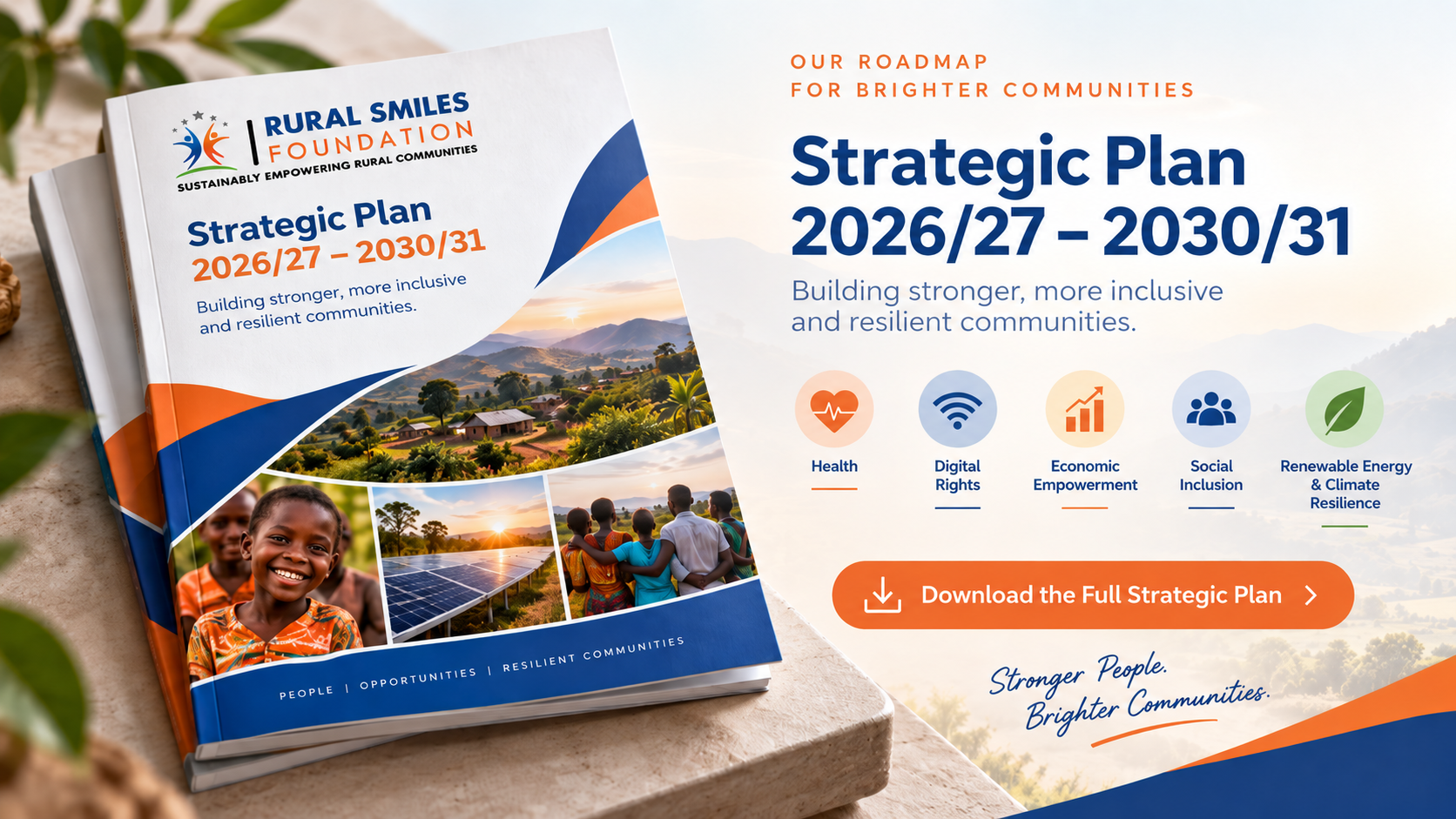
Rural Smiles Foundation’s Strategic Plan 2026/27–2030/31 provides our five-year direction for advancing rights, strengthening community resilience and building sustainable solutions with rural and underserved communities. It guides how we design programs, build partnerships, mobilise resources, strengthen our institution, generate evidence and remain accountable to the communities we serve.
The strategy reflects an important lesson from our work: the challenges communities experience are interconnected. Health cannot be separated from livelihoods, digital access from participation, or reliable energy from climate resilience. Our response therefore brings together rights, community empowerment, innovation and locally led development rather than addressing these issues in isolation.
Our Strategic Direction
From 2026/27 to 2030/31, Rural Smiles Foundation will strengthen its role as a community-rooted, rights-based and innovation-driven organisation. We will continue working alongside communities while strengthening partnerships with public institutions, civil society, technical organisations, research institutions, private-sector actors and development partners. Our focus is not only on expanding the number of activities we implement. We want to deepen the quality, sustainability and measurable impact of our work, strengthen local capacity and develop approaches that can be responsibly adapted to other communities.
Five Interconnected Programs
The Strategic Plan is organised around five institutional programs.
- Health & Health Rights advances community health, maternal and newborn health, sexual and reproductive health and rights, mental health, prevention, referral pathways, health literacy and resilient rural health systems.
- Digital Rights & Internet Freedom strengthens meaningful digital inclusion, online safety, privacy and data protection, civic technology, internet governance, responsible technology and safer digital participation.
- Economic Rights & Empowerment supports skills development, entrepreneurship, financial capability, digital and creative livelihoods, market access and stronger economic resilience for rural and underserved households.
- Social Inclusion & Civic Space strengthens inclusive participation, civic education, community dialogue, peacebuilding, social accountability, civil-society resilience and safer participation for communities and civic actors.
- Renewable Energy & Climate Resilience advances clean-energy access, climate adaptation, resilient rural services, sustainable livelihoods, youth climate leadership and community-led responses to environmental and climate risks. These five areas form the core of the organisation’s strategic direction.
How We Will Deliver the Strategy
Our implementation approach is participatory, inclusive and rights-based. We will work with communities to understand priorities, co-design appropriate responses and strengthen the people and institutions that can sustain change locally.
Across the five-year period, we will combine community engagement, capacity strengthening, advocacy, research, technology, innovation and practical service delivery. We will use monitoring, community feedback and evidence to understand what is working and continuously adapt our programs.
Partnership will remain central. Rural Smiles Foundation does not seek to replace public institutions or specialised organisations. Instead, we work to strengthen connections between communities, existing systems and partners with the expertise and resources needed to address complex challenges.
By 2030, we want Rural Smiles Foundation to be a stronger and more sustainable institution capable of delivering measurable community impact while remaining grounded in the people and places from which our work began. Our ambition is to contribute to communities that are healthier, more economically secure, digitally included, able to participate meaningfully in decisions, and better prepared to withstand climate and other emerging challenges.