


Hi there! How can we help you today?

The Uncertain Future of Civil Society in Uganda: Between Survival, Resistance, and Reinvention
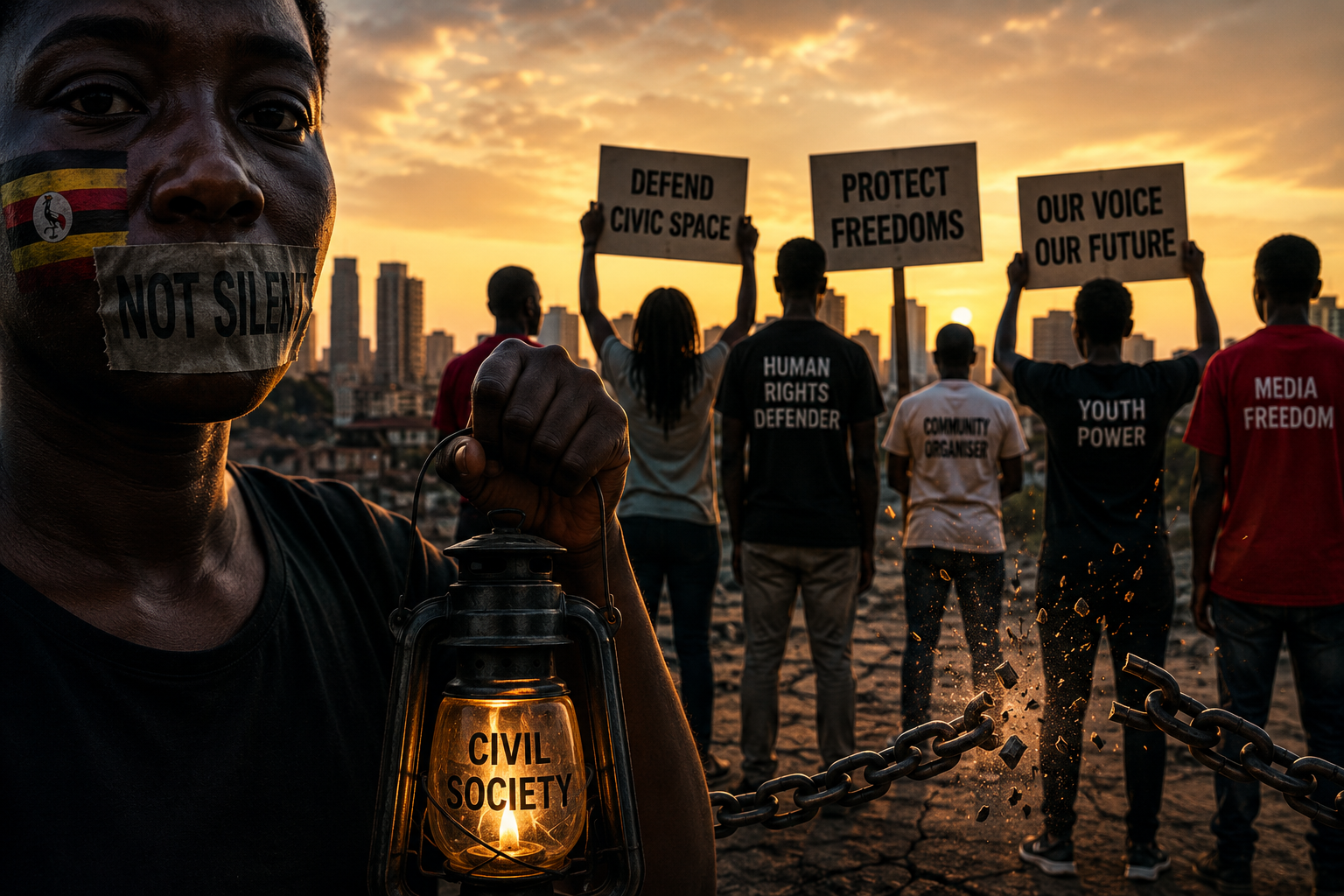
Uganda’s civil society stands at one of the most defining moments in its modern history. As the country moves deeper into a politically tense period following the 2026 elections, uncertainty has become the daily reality for many civil society organisations (CSOs), community activists, journalists, and human rights defenders.
Across the country, organisations that once operated openly are increasingly navigating fear, legal ambiguity, financial pressure, digital surveillance, and shrinking democratic space. What was once described as a “challenging environment” has evolved into something more profound: a struggle over the very legitimacy and survival of independent civic action in Uganda.
Recent developments paint a troubling picture. Several prominent Ugandan civil society organisations were suspended ahead of the 2026 elections, while internet shutdowns, social media restrictions, and growing pressure on journalists and defenders intensified concerns about the state of civic freedoms in the country. International human rights organisations, regional bodies, and global observers have repeatedly warned that Uganda is experiencing a significant contraction of civic space.
For many grassroots organisations, especially those working on governance, human rights, digital rights, electoral accountability, gender justice, and inclusion, the atmosphere is increasingly uncertain. The fear is no longer only about funding cuts or bureaucratic hurdles. It is about operational survival.
The Rise of Restrictive Civic Governance
One of the most significant concerns emerging in Uganda is the growing use of legal and administrative mechanisms to regulate and control civil society activity. While governments have legitimate oversight responsibilities, civil society actors increasingly fear that regulation is becoming weaponized against dissent and independent organising.
The recent signing of Uganda’s controversial “Protection of Sovereignty” law has intensified these fears. Critics argue that the law’s broad language around “foreign influence” could be used to criminalise legitimate advocacy, international partnerships, and policy engagement by civil society organisations.
This comes at a time when many Ugandan CSOs depend heavily on international partnerships and grants to sustain health programs, human rights monitoring, civic education, humanitarian interventions, and community development work. The possibility that foreign-supported civic work could increasingly be framed as “external interference” creates a dangerous precedent for organisations already operating under pressure.
At the same time, Uganda’s NGO Bureau has continued to exercise expansive powers over registration, permits, and operational compliance. The suspension of several organisations ahead of the elections raised serious concerns among regional and international observers regarding due process and freedom of association. For many smaller community-based organisations without legal teams or international visibility, these uncertainties create fear, self-censorship, and institutional paralysis.
The Digital Battlefield
Uganda’s civic space is no longer only contested physically. It is increasingly contested digitally. Internet shutdowns, online surveillance fears, cyber harassment, and restrictions on online expression have transformed the digital space into another arena of political control. During the 2026 electoral period, internet disruptions and social media restrictions once again affected journalists, civic actors, and election observers. This has major implications for modern civil society work.
Today, advocacy campaigns, emergency response coordination, documentation of abuses, fundraising, public mobilisation, and citizen reporting all rely heavily on digital platforms. When digital access is disrupted, civic participation itself becomes restricted. Human rights defenders and civic actors are also increasingly facing online threats, disinformation campaigns, hacking attempts, and digital intimidation. For many organisations, digital security is no longer optional it has become central to institutional survival.
Yet even amid these threats, many Ugandan civic actors are adapting. Community-led digital monitoring platforms, encrypted communication practices, online documentation systems, and grassroots digital organising are emerging as critical tools for resilience. The struggle for civic space in Uganda is therefore no longer only about physical assembly or office operations. It is equally about control over information, communication, and visibility.
Funding Crisis and Institutional Fragility
Beyond political restrictions, Ugandan civil society is also facing a quiet but devastating financial crisis. Many international donors are shifting priorities globally due to geopolitical conflicts, economic instability, and changing development agendas. Smaller grassroots organisations are often the hardest hit. Rising compliance requirements, short-term funding cycles, and increasing donor caution around politically sensitive work are making sustainability difficult.
For many local organisations, survival now depends on project-based grants with limited operational support. This weakens institutional stability, staff retention, and long-term planning. Organisations working in civic engagement, accountability, democracy, and human rights often face greater scrutiny than service delivery organisations. Some donors are becoming more cautious about supporting advocacy work in politically restrictive environments, leaving many civic actors exposed. This creates a dangerous imbalance: the need for civic accountability grows, while the resources to sustain that work continue shrinking.
But Civil Society Is Not Defeated
Despite the uncertainty, Ugandan civil society is far from defeated. Across rural districts, urban communities, youth movements, women-led initiatives, digital rights organisations, community media groups, and grassroots networks, civic actors continue to organise, educate, document, advocate, and support vulnerable communities. What is changing is the strategy. Many organisations are increasingly shifting toward decentralized community organising, coalition-building and solidarity networks, digital resilience and secure communication, participatory governance approaches, community-owned advocacy, local philanthropy and social enterprise models, regional and international collaboration. Civil society in Uganda is entering an era where resilience may matter more than visibility. The future may belong less to large, centralized institutions and more to adaptive, community-rooted movements capable of surviving pressure while remaining connected to citizens’ everyday struggles.
The Real Question Facing Uganda
The future of civil society in Uganda is not only a question for NGOs or activists. It is a question about the future of democracy, accountability, inclusion, and citizen participation itself. When civic space shrinks, communities lose more than organisations. They lose watchdogs against corruption, defenders of rights, advocates for vulnerable populations, and platforms for peaceful participation. Strong civil society does not weaken a country. It strengthens it. Uganda’s future stability, development, and democratic legitimacy will depend heavily on whether independent civic voices are protected or silenced. At this moment of uncertainty, one thing remains clear. Ugandan civil society may be under pressure, but it continues to evolve, resist, and reimagine new ways to serve communities and defend civic freedoms. And perhaps that resilience itself is the strongest sign that civic space, though shrinking, is not yet extinguished.
Related Posts

News Rural Smiles Foundation Signs One-Year Fiscal Sponsorship Agreement with The New Africa Fund to Strengthen International Giving and Locally Led Development
News Call for Applications: Western Region Youth Climate Action Workshop
Rural Smiles Foundation, the Western Regional Hosting Organization of the Youth Climate Council (YCC...